At the College of Europe in Natolin, the European Civilization Chair supports a diverse programme of events beyond the classroom that investigates the meanings and impacts of history. Through public debates, student-led initiatives, discussions, guided visits, film screenings, and so much more, the Chair invites the Natolin community to participate in the enduring significance of Europe’s complex past.
These events form part of the Chair’s broader mission to support historical reflection as a vital resource for civic understanding and public responsibility. Some activities focus on moments of rupture and transformation in Europe’s twentieth century, such as the Cold War and the Holocaust as well as the revolutions of 1989 and the continuing war in Ukraine. Other events turn to deeper historical legacies including the dynamics of political and religious pluralism in the Polish-Lithuanian Commonwealth, legacies of Enlightenment thought, and shifting border conflicts within Europe over the centuries. As a whole, they offer students a chance to ask how Europe has been imagined, governed, contested, and remembered—and to do so in conversation with witnesses, policymakers, scholars, and peers.
Recent events have included high-level debates on war and solidarity in international politics; commemorative visits and meetings with survivors of Auschwitz and the Warsaw Ghetto; workshops on public memory; and “Meet the Author” conversations with leading historians and public thinkers. Study visits in Warsaw and across Poland ground these conversations in place, while film screenings, musical evenings, and interdisciplinary collaborations help foster a culture of shared engagement beyond disciplinary boundaries.
A recent major initiative, the Three Ukrainian Revolutions (3R) Project, has brought together students, scholars, and international experts to reflect on the protest movements of 1990, 2004–2005, and 2013–2014. Drawing on oral histories and comparative analytics, the project traces the democratic and geopolitical implications of Ukraine’s modern revolutionary history. Since the outbreak of Russia’s invasion in 2022, the 3R Project has continued to explore junctures of political protest, memory, and war. Learn more about the 3R Project here.
Through these active community engagements, the Chair aims to create a space for curiosity and serious thought in which students from all disciplines deepen their understanding of European and global histories, sharpen their interpretive skills, and take part in the intellectual and civic life of the College.
Recent events include:
Three Ukrainian Revolutions (3R Project)
- Meet the Authors: Presentation of the 4th Volume of the 3R Project "The End of the Soviet World? Essays on Post-Communist Political and Social Change" by Prof. Richard BUTTERWICK-PAWLIKOWSKI and Prof. Georges MINK (21/02/2025)
- International Symposium: "Ten Years of Russia's War against Ukraine. The Long End of the Post-Soviet Era" (26/3/2024)
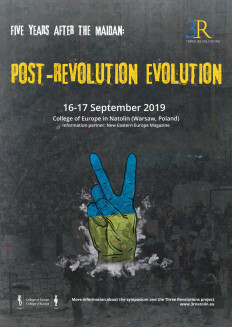
- International Symposium: "Five years after the Maidan: post-revolution evolution" (16-17/9/2019)
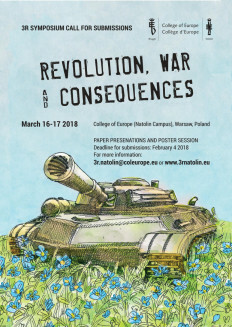
- International Symposium: "3R: Revolution, War and their Consequences" (16-17/3/2018)
- Debate: "Between Russian Empires. One hundred years on" (15/3/2018)
- International Symposium: "Three Revolutions – Portraits of Ukraine" (28/2-1/3/2017)
- International Conference: "The Fate of Freedom in Eastern Europe: Autocracy – Oligarchy – Anarchy?" (22-23/9/2016)
- International Conference: "Revolutions, maidans and protests in contemporary Ukraine. The current state of research and future directions" (20/6/2016)
- Seminar: "The Oral History of Ukrainian Revolutions" (19/2/2016)
- Seminar: "Oral history as a source for researching political breakthroughs in the context of Ukrainian revolutionary movements 1990-2014" (December 2015)
Recent Events
Past Events
2020-2024
- Visit to the Polish History Museum in Warsaw (17/11/2024)
- Field Visit to Powązki Cemeteries on All Saints' Day (1/11/2024)
- Workshop on “Where do innovation and creativity come from? Some historical perspectives on individual geniuses and collective processes” with Dr Raffaele DANNA (11/04/2024)
- Meet the Author: Discussion on Sylvie KAUFFMANN's Latest Book "Les aveuglés, comment Berlin et Paris ont ouvert la voie à la Russie" (19/01/2024)
- The Auschwitz-Birkenau Educational Project at Natolin: Study Visit to the Museum and Memorial (01/12/2023)
- High-level Lecture by Dr Piotr M.A. CYWIŃSKI, Director of the Museum and Memorial Auschwitz-Birkenau (27/10/2023)
- Visit of Mr Marian TURSKI, one of the last living survivors of Auschwitz-Birkenau (19/10/2023)
- Meeting with Ms Krystyna BUDNICKA, Warsaw Ghetto Uprising Survivor, on the occasion of commemoration of the 80th anniversary of the Uprising (15/04/2023)
- Screening of 'Cold War' film and Discussion with Professors Georges MINK and Marek CICHOCKI (05/03/2023)
- Conference: "Searching for a New Form of Solidarity" (24/02/2023)
- "Legacy of the Cold War" - Second Debate Organised by the European Civilisation Chair with Prof. Jussi HANHIMAKI and Prof. Glenda SLUGA (25/01/2023)
- "Legacy of the Cold War" - First Debate by the European Civilisation Chair with Prof. Hans KUNDNANI and Mr Michał BARANOWSKI
- "Legacy of the Cold War" - Workshop by the European Civilisation Chair with Prof. Marek CICHOCKI and Dr Paweł UKIELSKI (10/11/2023)
- High-level discussion with Dr Piotr M.A. CYWIŃSKI, Director of the Museum and Memorial Auschwitz-Birkenau (21/11/2022)
- Screening of “Mr. Jones” and special meeting with its authors (Ms Agnieszka HOLLAND), the Ambassador of Ukraine to Poland Mr Vasyl ZVARYCH, and relatives of Gareth Jones (22/10/2023)
- Meeting and discussion with Mr Marian TURSKI, one of the few living survivors of Auschwitz-Birkenau (13/10/2022)
- Rencontre avec le Professeur Krzysztof POMIAN - auteur de la trilogie « Le musée, une histoire mondiale » (27/04/2022)
- « Meet the Authors » : Prof. Chantal DELSOL et son nouveau livre sur l'Europe centrale et orientale depuis 1945 (28/2/2022)
- Screening of the film "Mr. Jones" and debate with the director of the film Agnieszka HOLLAND and Ukrainian Ambassador to Poland Andrii DESHCHYTSIA (21/11/2021)
- Special meeting with Mr Marian TURSKI, one of the few living survivors of Auschwitz-Birkenau (15/10/2021)
- Workshops in cooperation with the European University Institute by Max Weber Fellows (06-07/04/2021)
- Screening of "Denial" and discussion with Dr Piotr CYWIŃSKI, Director of the Museum and Memorial Auschwitz-Birkenau (14/2/2021)
- High-level discussion with Prof. Dariusz STOLA, Polish Academy of Sciences, on the movie "Sophie's Choice" (18/11/2020)/
- Seminar "Nouveau regard sur l'épopée de Solidarność" by Professor Anna SZCZEPAŃSKA and screening of her film (15/11/2020)
- Online "Meet the Authors" meeting with Mr Roger MOORHOUSE, co-organized with the Natolin Library (22/4/2020)
- Online Workshop led by Dr Julie DESCHEPPER: "Heritage(s) of Socialism in Europe: Current Debates and New Approaches", co-organized with the EUI Max Weber Programme (15/4/2020)
- Online Workshop led by Dr Anca CRETU: "Humanitarianism in Historical Perspective", co-organized with the EUI Max Weber Programme (8/4/2020)
2019-2011