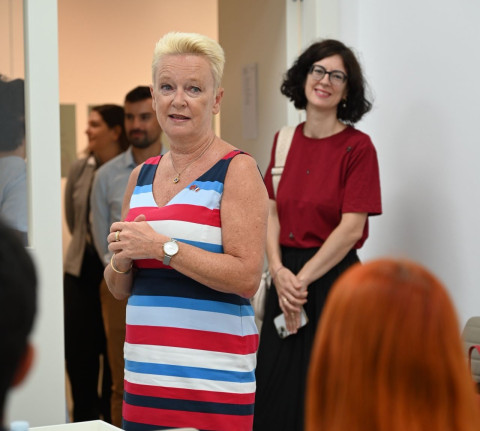
Library X IDEAs book presentations
during lunch break
Due to the great success of the first semester's 'Library & IDEAs Book Presentations during Lunch Break', the series continued during the second semester with 5 additional dates! All pictures of the book presentations of the second semester of 2026 can be found here!
01.04.2026 - Library x IDEAs – Book presentation during lunch break with Vincent Guerre.
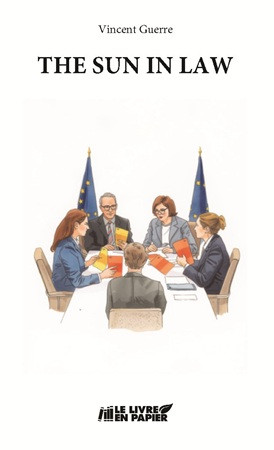
On Wednesday April 1st 2026, the library - together with IDEAs (Inter-Departmental European Advanced Studies) – organized the fifth and final book presentation during lunch break of the second semester.
For this promotion’s final book presentation, we invited Vincent Guerre as our external speaker. Vincent presented his book ‘The sun in law: how the European Union would legislate on the colour of the sun’.
Vincent Guerre worked in EU institutions for 14 years. First as an adviser to a Member of the European Parliament, and later as a policy officer at the European Commission. In these roles, he was at the heart of EU policymaking, closely involved in the drafting and negotiation of several laws. Now outside the EU institutions, he remains active within the broader ‘EU bubble’ as both a lobbyist and a lecturer. He is currently employed as Director for Trade & Competitiveness at Shipyards' & Maritime Equipment Association of Europe, Brussels.
Vincent Guerre immediately captivated the audience by outlining his book. Reading ‘The sun in law’ enables you to discover how the European Union really works; and it does so, through a fictional and at times highly satirical tale about an EU law regulating the colour of the sun. An absurd subject - yet an accurate description of the policymaking process. It all started when the European Union discovered that the sun didn’t look the same everywhere in Europe. In Portugal, it glowed a rich orange; in Poland, it shone a pale yellow. Tourists were confused, weather apps didn’t know what to do, and paint companies panicked. Soon, lobbyists and politicians demanded action, because the European single market required harmonised sunlight. And so began the great technocratic quest to regulate the colour of the sun. Committees met, experts debated, and Member States argued over whether their skies were ‘mild apricot’ or ‘burnt mango’. Will the European Union find the perfect compromise and put the sun into law? Absurd? Absolutely! But behind the satire, this book’s story follows every step of a real policymaking process, revealing how the European Union really functions, or sometimes malfunctions. From Commission inter-service groups to Parliament shadow meetings, from obscure Coreper negotiations to late-night trilogues where every comma becomes a battlefield, the book explores the world of EU policymaking with a dose of humour. The stories are crazy, but the processes described are real. The author had to find a good balance between the facts and the satire; he does not want to seem to be laughing with the EU, because he is not looking down on the EU. Satire is not sarcasm; it is gently critical, it is not meant to be ’mean’.

The author stressed that his unusual book is a case study; a case study on decision-making and legislation making in the EU. He wanted to explain in a simple, engaging and funny way what the mechanics of the EU are and how they operate. He also touched upon ‘the 4 I’s of EU policies: Individuals, Institutions, Ideas and Interests. These four factors are present in all policies. He also made a comparison with hard sciences and policy-making; there are mechanisms in the system, like biology, and there is political chemistry. There is also alchemy: unexpected outcomes, things that cannot be explained or predicted.
Mr. Guerre left us with some advice: Learn the language that is used in the bubble! Sometimes we in the bubble are too shy to criticize things that are absurd, do not be afraid to criticize. Criticizing is not the same as condemning! The EU must not be taken too serious ; institutions are not meant to be idolized
One of the questions raised during the Q&A session that followed the presentation was: ‘Is there over-regulation in the EU?’ Yes and NO, the answer is of course nuanced, but we must see it as a necessity at times, for example, sometimes sets of regulations that have been around forever need to be reviewed in order to adapt them to the changing times.
11.03.2026 - Library x IDEAs – Book presentation during lunch break with Prof. Claudia Wiesner.
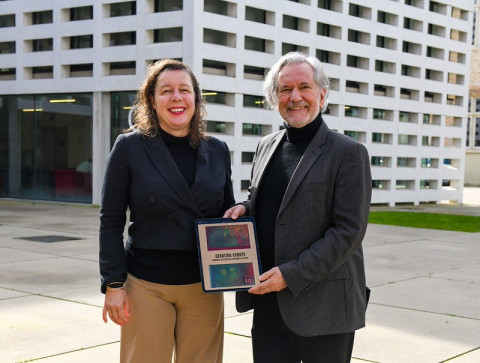
On Wednesday March 11th 2026, the library - together with IDEAs (Inter-Departmental European Advanced Studies) – organized the fourth book presentation during lunch break of the second semester. Professor Claudia Wiesner presented her book 'Debating Europe: Towards the Critical Informed Citizen?'. The book will be released as open access soon.
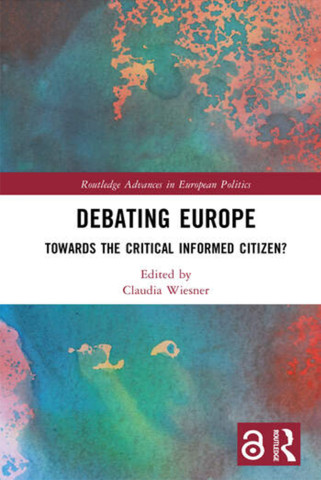
This book examines how Europe and the European Union are debated, politicised, and contested in a group of key (future) actors of European integration. Based on detailed focus group discussions with students in EU Studies and the Social Sciences from six EU countries, the book presents the core results of the theoretical, conceptual and empirical work of the Jean Monnet Networks "Debating Europe" (www.debating-europe.de) that set out to study the gap between the EU and its citizens. It first theorises and conceptualises Euroscepticism and politicisation, before presenting the core empirical findings from the collective research. These findings show that student’ views on democracy in the EU are similar across the countries. Quite unexpectedly, students express strong claims to the EU, lining out a “Normative Power Europe 2.0” that is a global actor, defends democracy, and fights climate change. The EU is associated with values such as equality, freedom, and the rule of law. In particular, non-EU citizens see the EU as an ideal. Students make out several gaps: between citizens and EU institutions, among different member states, and among citizens. Finally, the results reveal the students as critical and informed, but passive EU citizens.
- The puzzle:
- There is a growing gap between EU elites and EU citizens;
- The EU has a legitimacy problem and EU criticism spreads;
- Support rates decreased during the financial crises;
- We see a rise of anti-EU campaigns, and populist parties.
- The goals:
- The Jean Monnet Network "Debating Europe" (www.debating-europe.de) uses debate as a methodology, as a democratic practice, a tool in order to:
- Generate a dialogue and an enhanced understanding of the EU
- Learn what citizens’ reasons are to be critical of the EU
- Spread knowledge about the EU and critically discuss it.
- The Research Design:
- Due to the Pandemic in 2020, it was difficult to work with focus groups; ‘live debate’ became impossible; so, this led to a shifting focus on MA students in European studies. So instead of a general perspective it shifted to students on EU studies, who know so much about the EU! The students proved not only to be very well informed on the EU but also to be very critical. Democracy relies on critical citizens! You can support the EU and be critical as well. Over 100 students from 6 countries were questioned over 3 years! (Bulgaria, Croatia, Finland, France, Germany, and Slovenia)
- Long questionnaire on three topics: Democracy, European identity, and Politicisation!
- Key Findings:
- Students have a comprehensive picture of the EU as “Normative power 2.0” – almost a utopia!
- They want the EU to be a global actor and expect the EU to deliver;
- Key Similarities:
- The students’ view on the EU is positive and quite similar
- MA students are critically informed EU citizens and they do have EU criticism, which must not be mistaken for euroscepticism! For example; they are very fond of the European Parliament because they are directly elected, and they are critical of the Commission and the Council because they are not elected and that seems less democratic.
- They see the same topics as most important (eg. Climate change) and as most polarised (eg. Migration)
- Key Differences:
- There are different national patterns and naratives;
- And different motivers for EU support: utilitarian vs normative
- Conclusions:
- There is an overwhelming feeling of the EU being a ‘good’ and important project, as a model of supranational democracy but it is too complex, not transparent enough and not up to its possibilities;
- Most important are: the common market, the Euro, free movement and also the Erasmus project!
- The most polarizing topics are migration and climate change;
- The students claim for the EU to become a stronger actor but at the same time they are passive! They do not know how to politicise the EU; they do not see themselves as actors.
The findings invite to rethink the key concepts of the field of research: politicisation, democratisation and euroscepticism.
Prof. Claudia Wiesner’s well-appreciated presentation was followed by a Q&A session.
04.03.2026 - Library x IDEAs – Book presentation during lunch break with Book presentation during lunch break with Prof. Marieke Louis & Dr. Bob Reinalda.
On Wednesday March 4th 2026, the library - together with IDEAs (Inter-Departmental European Advanced Studies) – organized their third book presentation during lunch break.
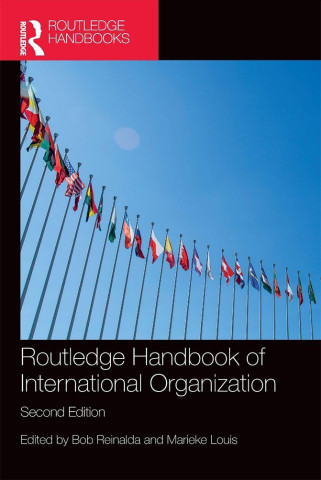
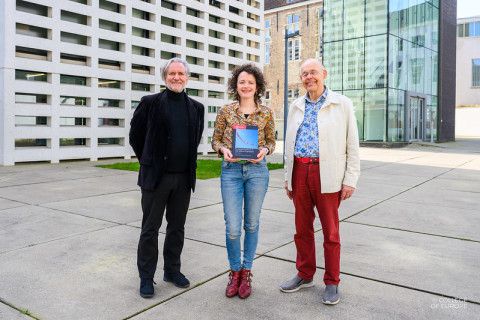 Prof. Marieke Louis and Dr. Bob Reinalda put the spotlight on their book 'Routledge Handbook of International Organization – second edition'. You can read the e-book version here: https://coleurope.on.worldcat.org/oclc/1485034185
Our guest speakers today were Dr. Bob Reinalda and Prof. Marieke Louis. Dr. Reinalda - from the Radboud University - is specialized in international relations and social history. Marieke Louis - from Sciences Po Lille and Centre Marc Bloch – kicked off the book presentation. The book ‘Routledge Handbook of International Organization’ is seen as ‘the major reference on international organizations. It is a very diverse handbook, comprised of many chapters, by many different authors on various topics (66 authors, 46 chapters).
The question that Prof. Louis addressed first was: ‘Why a new second edition of this handbook?’. Some of the reason stated were: the book deals with a troubled context and in a dynamic field; there are renewed questions on (dys)functional multilateralism, but even when international organizations are under attack or submitted to criticism, they remain ‘central’; a new edition to show the mixed methods and pluridisciplinarity:you do no longer need an international relations background to study International organizations (part 1 of the book); to illustrate the resilience of international and regional bureaucracies (part 2 of the book); to highlight profusion of actors and hybrids, formal & informal (part 3 of the book); because of transversal processes: eg. crisis management and learning (part 4 of the book); there were new challenges: eg. non-human threats and biodiversity; feminization of International Organizations, the diplomats from the Eastern Bloc, International organizations as shadow negotiators, the digital age (part 5 of the book).
International organization is (more than ever) worth studying! What matters most, in this field of study is the process over the institutions. The authors of the book noticed that Westernization is apparent, and they saw that recent rise of populism is a serious challenge to International organization. International organization studies are an autonomous and plural field.
Why is the title of the handbook ‘International Organization’ (singular) instead of ‘International Organizations’ (plural)? It is not about defending International organizations, but about finding the more general and common processes of organizing the word with different values!
Next up was Dr. Bob Reinalda, who shared some ‘tips’ on international networking: do not use titles; the dinners afterwards are important; book fairs and international conferences are important: be there & socialize; exchanges are important (eg. Erasmus), experience other countries & perspectives (teacher exchange); become a member of International research associations/committees; participate in editorial teams: it will get you an overview of the field; contact with international publishers is also important; learn to write in a foreign language; Specialize in your own field!
The book presents an overview of the theoretical perspectives and methods that can be used when studying International Organization, that is why it’s a helpful tool!
The Q&A session following the presentation was very lively. One of the questions was: Is it useful to have International Organization as a field of science, since it is such a diverse and difficult thing to grasp?! Answer: No one will ever claim to be a specialist of International Organization; merely of one or two or even three. International Organization singular is a process.
25.02.2026 - Library x IDEAs – Book presentation during lunch break with Book presentation during lunch break with Prof. Giselle Bosse.
On Wednesday February 25th 2026, the library - together with IDEAs (Inter-Departmental European Advanced Studies) – organized their second book presentation during lunch break.
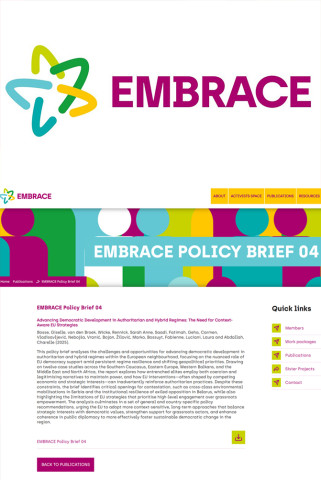
Prof. Giselle Bosse - a College of Europe visiting professor for many years - and Elena Ventura presented two Horizon Europe projects: the EMBRACE Democracy project (which has already come to an end) end the ongoing InvigoratEU project - through Prof. Bosse's report - 'Advancing Democratic Development in Authoritarian and Hybrid Regimes: The Need for Context-Aware EU Strategies - EMBRACE Policy Brief 04/2025.'
Horizon Europe is the EU’s key funding programme for research and innovation. It tackles climate change, helps to achieve the UN’s Sustainable Development Goals and boosts the EU’s competitiveness and growth. The programme facilitates collaboration and strengthens the impact of research and innovation in developing, supporting and implementing EU policies while tackling global challenges. Horizon is an initiative by the European Commission to implement policies with insight from academia.
The EMBRACE project started 4 years ago, and developed work programmes in a variety of areas, all focused on democracy promotion. Two consortia were formed, with between 8 and 18 partners, including universities, think tanks, civil societies, and so on. The project aimed at European democracy support in the EU Neighbourhood. Sadly enough, the project was hugely impacted by enormous changes in the international environment during the course of the project: the Russian invasion in Ukraine; the Hamas attach and the following Israelian-Palestinian war, Gaza & Israel, the situation in Africa, Algeria.
Professor Bosse focused on the various phases during such a project: conceptualization, empirical research with locals, the making of policy briefs.

Next up was Elena Ventura who presented the ‘InvigoratEU’ project and its ‘Triple R approach’: An important goal of the InvigoratEU project is to investigate how to Reform the EU’s enlargement strategy in a new geopolitical phase, how to Respond to other actors’ geopolitical ambitions in the Eastern Neighbourhood and Western Balkans, and how to Rebould/Reinvent the EU’s foreign policy arsenal in view of a new era of military threats combining the modernisation and geopolitical logics of EU enlargement, leading to new data – e.g. a public opinion survey in Ukraine, a set of scenarios, an external influence index (Russia, China, Turkey), and a social policy compliance and cohesion scoreboard.
She continued with addressing many cases, commenting on democracy and security having become linked and intertwined, due to the recent geopolitical developments. One of the cases being the Eastern Neighbourhood and the political pressures it faces.
During the Q&A session following topics were handled: anti-EU narratives in the western Balkans, frozen conflict areas such as Transnistria, how to conduct research in dangerous areas.
18.02.2026 - Library x IDEAs – Book presentation during lunch break with Prof. Michael Kaeding.
 On Wednesday February 18th 2026, the library - together with IDEAs (Inter-Departmental European Advanced Studies) – organized their first book presentation during lunch break of this second semester!
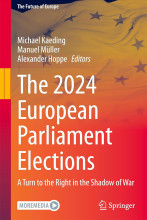
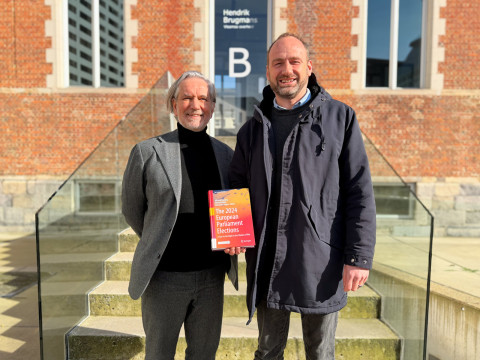
Professor Michael Kaeding presented his book ‘The 2024 European Parliament Elections, A Turn to the Right in the Shadow of War'.
As Professor Kaeding reviewed the contents of his book, he touched upon the following topics.
While the euro crisis, the asylum crisis, Brexit and climate change had already left their mark on the 2014 and 2019 elections, by 2024, crises had become even more immediate: the Covid-19 pandemic, the war in Ukraine, the Middle East conflict, the energy cost and the cost-of-living crisis.
While turnout remained remarkably stable (50,7 %) in comparison to 2019 (50,66 %), the 2024 elections brought a turn to the right with shifting majorities and new political groups in the European Parliament. In 2024, the party system in the EP is more fragmented than ever before and the “grand coalition” (EPP & S&D) no longer has its own majority. Despite ideological similarities, national party competition prevents the formation of a joint parliamentary group of right-wing parties.
The democratic principle of electoral equality applies to European elections at national level, but not EU-wide, as the number of votes required to win a seat strongly varies across member states.
Finally, a possible scenario for the composition of the European Parliament in a fully enlarged European Union (EU-37) shows no dramatic change in the seat distribution. The biggest change would be the massive increase in the number of non-attached members (NI) to 14.8%, as many parties from the 10 new member states (especially Turkey and Ukraine) have not yet been assigned.
During the Q&A session the focus was on the impact of mandatory voting on the EU-37 scenario, the impact of the US on the results of the EP elections, the voters for extreme right, the different strategies of (right-wing) parties to mobilize young voters on TikTok and the effect of the voting age of 16.
All photos of the IDEAs x Library of these past book presentations during lunch: here - Flickr!
29.10.2025 - Library x IDEAs – Book presentation during lunch break with Prof. Jacques Rupnik

On Wednesday October 29th 2025, the library - together with IDEAs (Inter-Departmental European Advanced Studies) – organize the fifth and final book presentation during lunch break of the first semester. Once again, the room was packed.
Professors Jacques Rupnik will presented his book Josef Guttmann et le destin de l'Europe centrale entre Hitler et Staline (to be published)
Two lives, two names, two perspectives on Soviet communism and its post-war expansion into Eastern Europe. They may seem neatly separated, yet they are united by one man’s experience and his attempt to understand the hopes and tragedies of the 20th century. Josef Guttmann, a leftist intellectual and later member of the Communist Party leadership, broke with the party in the early 1930s, becoming, alongside Záviš Kalandra, a prominent anti-leftist. He left Czechoslovakia at the end of 1938 and three years later settled in New York, where he worked under a pseudonym as an expert on events in the Soviet Bloc, a critic of totalitarianism and the author of the first articles on anti-Semitism in the Slanský trial. His Czech texts from the 1930s, together with studies and essays on the nature of communist regimes, genocide and anti-Semitism written in the United States, were selected by Jacques Rupnik and are being published in his native country for the first time.
22.10.2025 - Library x IDEAs – Book presentation during lunch break with Prof. Inge Govaere and Prof. Sacha Garben

On Wednesday October 22nd 2025, the library and IDEAs (Inter-Departmental European Advanced Studies) had their fourth book presentation during lunch break.
Professors Inge Govaere and Sacha Garben showcased their book The Impact of War (in Ukraine) on the EU (Govaere, I, Garben, S. & Spaventa, E. (eds). Bloomsbury, 2025)
You can read the book full text online here: https://coleurope.on.worldcat.org/oclc/1520505911
This timely book astutely charts the transformative effect of the war in Ukraine on the EU, from both a legal and policy perspective. The EU, itself a unique peace project born out of two world wars, consistently evolves from one security crisis to the next. Departing from the usual broad sweep of deepening and widening, this book focuses on the constitutional and substantive impact on the EU of the recent war in Ukraine. More so than ever before, this particular war proves to be a truly pivotal moment for the EU. Drawing on expert contributions from both academia and the EU institutions, this book offers a masterful exploration of how the EU is being challenged to the core.
15.10.2025 - Library x IDEAs – Book presentation during lunch break with Prof. Wolfram Kaiser

On Wednesday October 15th 2025, the library - together with IDEAs (Inter-Departmental European Advanced Studies) – proudly opened their third book presentation during lunch break of the new academic year. Professor Wolfram Kaiser talked about ...
- Kaiser, W. (2025). Histories of the European Parliament during the Cold War: Transnational Democracy in the Making?, Journal of Modern European History, 23(3), 286-304
Read the article here: Histories of the European Parliament during the Cold War: Transnational Democracy in the Making? - Wolfram Kaiser, 2025
This article introduces and discusses the incipient historiography of the European Parliament. It argues that more systematic research in this direction has strong potential to overcome limitations of research both on European integration and the member states. It can encourage and support those working on national history, or histories, to leave their intellectual ghettos and explore both vertical and horizontal connections in contemporary European history. Researching and writing about the history of the European Parliament can also contribute to a broader interdisciplinary debate about transnational democracy beyond the state, in what is now the highly institutionalized and legally integrated European Union. Focusing on the period of the Cold War, the article sets out a research agenda for addressing the internal politics of the European Parliament, its role in post-war European democracy and polity-building; and its underrated contribution to the Europeanization of policymaking. What could result is, befitting for a pluralistic democratic institution, not one, but several histories of the European Parliament and transnational democracy.
- European Parliament: Directorate-General for Parliamentary Research Services, Corbett, R., Kaiser, W., Schirmann, S., Warlouzet, L., & Wassenberg, B. (2024). Shaping European integration: the directly elected European Parliament, 1979-1989, Publications Office of the European Union
Read the publication here: https://op.europa.eu/en/publication-detail/-/publication/f24a60af-973b-11ef-a130-01aa75ed71a1
It is now possible, with four decades of hindsight, to look with a degree of historical perspective on the remarkable impact of the European Parliament in the years immediately after the first European elections. Having an elected Parliament among the institutions of the European Community was a step into the unknown. It was also a unique experiment: never had a transnational parliament been directly elected by citizens anywhere in the world. This volume brings together three studies that examine the dynamic of having full-time elected representatives, interacting and networking with the other institutions, governments, national parliaments, sectoral interests and political parties in the Member States, and how that helped create the dynamic for the transformation of the European Communities into the European Union as we now know it. This book, commissioned by the European Parliamentary Research Service, adds considerably to the literature and knowledge of the processes and dynamics that led to the European Parliament becoming such an important part of the European Union, and how it stimulated the development of the latter. It contains an introduction by former MEP Richard Corbett, who was the European Parliament’s co-rapporteur on the Constitutional and Lisbon Treaties, and three substantial studies by: Professor Wolfram Kaiser, on how the EP shaped institutional reform; Professor Laurent Warlouzet, on how it influenced the creation of the single market; Professors Birte Wassenberg and Sylvain Schirmann, on how it developed its own political culture.
08.10.2025 - Library x IDEAs – Book presentation during lunch break with Prof. Martin Westlake and Prof. Didier Georgakakis

On Wednesday October 8th 2025, the library - together with IDEAs (Inter-Departmental European Advanced Studies) – held their second book presentation during lunch break of the new academic year.
Professors Martin Westlake and Didier Georgakakis talked about a special issue they wrote for ‘European Politics and Society’ (Volume 26, Issue 2, 2025): People Building Europe: New Developments in EU Personnel and Professionals Studies.
You can read the special full text online here: https://coleurope.on.worldcat.org/oclc/1513884331
The editors examine the way in which EU personnel and professionals’ studies have developed and evolved over time, gradually branching out into different disciplines and different cultural traditions. They chart the way the literature has followed the growth and evolution of the EU itself, including more institutions, agencies and other bodies, more policy areas and more member states. They argue for an interdisciplinary approach whilst also pushing at the boundaries of different disciplines, concluding that such approaches can only strengthen the general impact of EU studies.
01.10.2025 - Library x IDEAs – Book presentation during lunch break with Prof. Hussein Kassim

On Wednesday October 1st 2025, the library - together with IDEAs (Inter-Departmental European Advanced Studies) – started off their book presentation series of the new academic year.
Professor Hussein Kassim presented his book National Government Narratives of the EU : 'Official Stories' of Belonging - Palgrave Studies in European Union Politics (published by Palgrave Macmillan in 2024) to students, staff and external visitors.
You can read the e-book version here: https://coleurope.on.worldcat.org/oclc/1504399123
The book examines and compares government narratives of the EU. It thereby addresses a topical issue of major political importance. Bringing together leading specialists from across Europe, it takes a first step in filling a gap in the scholarly literature where attention has focused mainly on narrative-making at the EU level or societal understandings of ‘Europe’. At a time when crises, the rise of Eurosceptic populism and the UK’s departure have revealed significant differences in how states view the purpose of the European Union and the significance and value of EU membership, it asks: How do governments explain and justify their relationship with the EU? How do these narratives change over time? What do these visions imply for the EU’s future?
During the Jacques Delors promotion of 2024-2025, the library and the European General Studies programme (EG) joined forces, culminating in the organization of book presentations. It allowed some of our (visiting) professors to present their scientific output to our College students and external visitors, in an informal setting, during lunch break. All presentations were moderated by Prof. Georgakakis.
All photos of the EG x Library book presentations during lunch: here - Flickr!
02.04.2025 - EG x Library – Book presentation during lunch with Prof. Stefana BROADBENT

Prof. Stefana Broadbent - "Pour une nouvelle culture de l'attention. Que faire de ces réseaux sociaux qui nous épuisent?" (Odile Jacob, 2024)
"Pour une nouvelle culture de l’attention. Que faire de ces réseaux sociaux qui nous épuisent" explores how, in the digital age, attention has become a commodified resource. The authors argue that individuals are increasingly treated as products in the "attention market," where personalized content, targeted advertising, and AI-driven interactions shape their behaviours.
The author ask to what extent does the commodification of attention threaten individual autonomy and democratic values?
Answering the question, they emphasize that:
1. beyond personal concerns (such as time management, children’s exposure, and financial risks), the large-scale capture of attention poses a fundamental threat to democracy;
2. the latter weakens individual agency, exacerbates social polarization, and impoverishes collective experience by exhausting cognitive resources;
3. digital platforms employ cognitive and psychosocial mechanisms to manipulate users’ decisions and extract data without their full awareness;
4. a new regulatory framework is necessary to mitigate these risks.
By combining insights from cognitive science, design, philosophy, and law, the authors advocate for an alternative approach to digital attention, one that prioritizes reflexivity, liberty, collaboration and reinforces the public space.
19.03.2025 - EG x Library – Book presentation during lunch with Prof. Hélène MICHEL

Prof. Hélène Michel - "Conflict of Interest and Medicine : Knowledge, Practices, and Mobilizations" (Routledge, 2022)
We had the pleasure of welcoming CoE Visiting Professor Hélène Michel to present her book “Conflict of Interest and Medicine: Knowledge, Practices, and Mobilizations”.
With growing concerns about the pharmaceutical industry’s influence on physicians, scientists, and policymakers, Prof. Michel explored how conflicts of interest have become a critical social issue, shaping medical expertise, public health policies, and the political economy of pharmaceutical knowledge.
Drawing from empirical investigations conducted across France, the EU, and the US, her presentation discussed how these dynamics impact medical practices and the politicization of public health risks.
A big thank you to Professor Michel for this insightful session and to our attendees for their enthusiastic participation!
05.03.2025 - EG x Library – Book presentation during lunch with Prof. Antoine VAUCHEZ

Prof. Antoine Vauchez - '"L'Europe: du marché à la puissance publique" (PUF, 2024)
Can the EU be more than just a market regulator?
As crises multiply, from war and pandemic to inflation and climate change, the European Union faces a defining question: can it truly become a public power and a full-fledged democracy?
In the third session of this semester’s book presentations series – jointly organized by our European General Studies Department and the College of Europe Library – Professor Antoine Vauchez challenged our students to rethink Europe’s role in times of crisis!
Presenting his book “L’Europe: du marché à la puissance publique”, he examined the EU’s struggle to move beyond its economic foundations and explored how taxation, budgeting, anti-corruption policies, and ecological transition could shape a Europe that prioritizes public goods over markets.
Many thanks to Prof. Vauchez for this timely discussion on the future of European power!
Photos of the book presentation can be found here!
26.02.2025 - EG x Library – Book presentation during lunch with Prof. Cécile ROBERT

Prof. Cécile Robert - "Political Sociology Perspectives on Lobbying in the EU" (Springer, to be published in 2025)
On February 26th, Professor Cécile Robert (Sciences Po Lyon), presented her book Political Sociology Perspectives on Lobbying in the EU. This book examines lobbying in the European Union, the practices and social trajectories of interest representatives working in Brussels. Lobbying now occupies a central place in the government of the European Union and is also at the heart of European politics, as shown by the recent Qatargate scandal. The subject of lobbying has a long history in political science, and lobbying the European Union has been the subject of now classic works and specialist journals, testifying to the great success of this subject. However, most of this work have left aside the question of the professional identity, trajectories and social properties of the actors who work on a daily basis in the coproduction of European public action. During the lecture, she highlighted 4 questions: Why take an interest in lobbying? Why advocate a sociological approach to lobbying and lobbyists? Why take an interest in lobbying when you're a future EU professional? Why advocate a sociological approach to lobbying and lobbyists?
Photos of the book presentation can be found here!
19.02.2025 - EG x Library – Book presentation during lunch with Prof. François FORET

Prof. François Foret - "The European Union in Search of Narratives. Disenchanted Europe?" (Routledge, 2025)
On February 19th, Professor François FORET (Université Libre de Bruxelles, CEVIPOL, EUI), President of the Institute for European studies, presented his book 'The European Union in Search of Narratives. Disenchanted Europe?'. In his book, Professor Foret examines the legitimization of the European Union through the development and rapid rotation of narratives aiming to convey its identity and purpose. He argues that three narratives have been dominant over the last 20 years: ‘Europe of rights’, ‘Europe of values’, and ‘European way of life’. He argues that European narratives express lower ambitions on charismatic community-building, are constantly expanding to new domains, and are increasingly framed as being in a situation of existential threat, which may increase democratic tensions and give rise to a populist backlash. Case studies are various 'crises' related to e.g., terrorism and radicalization, pandemics, and morality politics.
Photos of the book presentation can be found here!
06.11.2024 - EG x Library – Book presentation during lunch with Prof. Didier GEORGAKAKIS

On November 6th 2024, Prof. Didier GEORGAKAKIS presented a special issue of the Politique européenne journal he oversaw (forthcoming publication). Emerging from a colloquium the European general studies programme organized in 2022, on the anthropology of the European institutions, this issue analyses the EU institutions from inside by gathering a wide range of contributions standing closely to the daily practices of a variety of actors of the field of the EU institutions. It asks the questions: how works a session of the EU council? What is the daily life in Commissioners’ cabinets, in the German ministry of economy in charge of EU, in lobbies or in agencies? What does it tell us about power, culture and concrete institutions? And with what added value or limits compared to other perspectives?
This special issue contains a lot of food for thought about the EU institutions and policies in view of the students’ thesis. It also represents a true opportunity for the students ahead of their internship – especially if they are seeking a blue book internship given Prof. Georgakakis longstanding research on the Commission’s officials – to get insights from a researcher on the European administrative and political space and ask questions.
09.10.2024 - EG x Library – Book presentation during lunch with Prof. Jean-Frédéric SCHAUB

Professor Jean-Frédéric Schaub presented his book Nous avons tous la même histoire : les défis de l'identité (published by Odil Jakob in 2024) to students, staff and external visitors.
L’ouvrage de Jean-Frédéric Schaub explore la tension entre l’histoire en tant que discipline scientifique et son instrumentalisation politique. Avec cet ouvrage, il entend redonner à l’histoire son autonomie scientifique et son indépendance intellectuelle. Dans cette perspective, il explore les questions de la mémoire, de la vérité et de l’objectivité, et prône un universalisme méthodologique.
His discourse was followed by a short and illuminating Q&A-session with the students.
02.10.2024 - EG x Library – Book presentation during lunch with Prof. Jan ZIELONKA

Prof. Jan ZIELONKA - "The Lost Future and How to Reclaim It" (Yale University Press, 2023)
The future seems increasingly uncertain. Our democracies are failing to prevent financial crises, energy shortages, climate change, and war because they are confined to the borders of nation-states, defending the short-term interests of present-day voters. The consequences for future generations are dire. In his book, Prof. Zielonka makes a bold case for a new politics of time and space in sync with the digital era.
Access Prof. Zielonka’s book here.
12.04.2024: EG x Library present "A talk with Prof. Didier BIGO"

On Friday April 12 at 14h00 in Room C, Prof. Didier Bigo presented his contributions to several publications. He did this in a talk entitled ‘How to analyse the mix of security-diplomacy and war today: alternatives from critical EU security studies’. Some of the books Prof. Bigo contributed to are: The Routledge Handbook of Critical European Studies and Intelligence oversight in times of transnational impunity : who will watch the watchers?