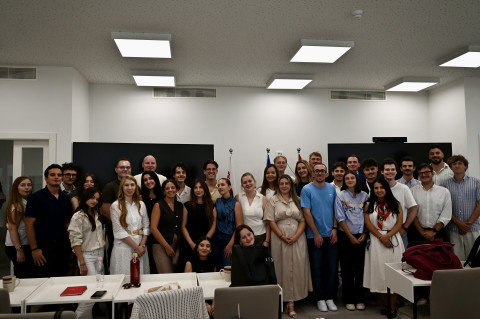
Erasmus+ supports training or teaching periods for staff working in higher education institutions. With Erasmus+, you can train or teach at a higher education institution in an Erasmus+ Programme or Partner country or at organizations outside the sector in a Programme country.
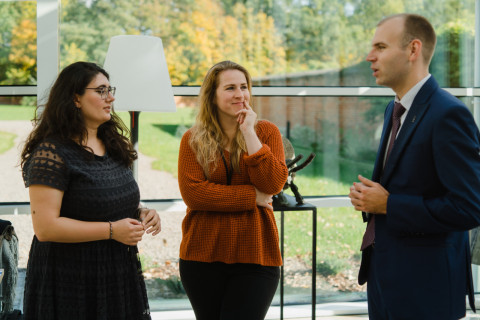 Examples of such organizations include Higher Education Institutions (HEIs), businesses, public bodies, social partners, research institutes or non-governmental organizations. Staff may carry out any of the activities described below:
- A teaching period abroad at a partner higher education institution (at least 8 hours of teaching);
- A training period abroad at a partner higher education institution, enterprise, or any other relevant workplace. It may take the form of training events or job shadowing and observation periods (entirely passive activities, such as mass conferences, are not supported).
A staff mobility period abroad can combine teaching and training activities. If the teaching activity is combined with a training activity, the minimum number of hours of teaching per week (or any shorter period of stay) is limited to 4 hours. Any teaching or training period abroad may be carried out as blended mobility.
Blended intensive programmes (BIP): BIP is a short-term intensive training programme that uses innovative learning and teaching methods, combining physical mobility abroad with a compulsory virtual component enabling online teamwork. Within the framework of the BIP, the participant can carry out mobility for teaching or training purposes. Participation in BIP must contribute to increasing the employee's skills and knowledge: https://wikis.ec.europa.eu/spaces/NAITDOC/pages/95553249/Blended+Intensive+Programmes
In particular, we invite all students and staff to join traineeship/staff mobility programmes which could develop your digital skills, (we add) better understanding of diversity and inclusion, deeper knowledge about participation in democratic life, common values and civic engagement, or environmental, climate and sustainability issues. In general please read about the ER+ priorities: https://erasmus-plus.ec.europa.eu/programme-guide/part-a/priorities-of-the-erasmus-programme.
Partner Countries - International mobility involving third countries not associated with the programme
The primary focus of the higher education mobility action is to support mobility activities among EU Member States and third countries associated with the Programme – the European dimension. However, the action also supports the international dimension through two strands of mobility activities involving third countries not associated with the Programme across the whole world. One strand supports mobility to all third countries not associated with the Programme (regions 1-14) and is funded by EU internal policy funds (EU budget Heading 2 - Cohesion, resilience, and values). Another strand supports mobility to and from third countries not associated with the Programme (with the exception of regions 13 and 14) and is funded by EU external action instruments.
Duration
A training period between two Programme countries must last a minimum of 2 days and cannot last more than 2 months. This excludes traveling time. A training period between a Programme country and a Partner country must last a minimum of 5 days and cannot last more than 2 months. This excludes traveling time.
Conditions
The following groups of staff, building the general learning and teaching community of the College, may take part in mobility programmes: non-teaching staff (administrative), academic staff and lecturers. The participants must have relevant language skills. Participants are selected by the CoEN, based on predefined criteria of selection.
Each academic year we provide a dedicated call for all staff members, accompanied by a dedicated set of rules and regulations, consultations and meetings, including intranet if necessary, related to a particular call and mobility project. This also includes relevant fees for individual support, which may be slightly different in selected mobility projects (and are publicly available, including the internet site of the Polish National Erasmus+ Agency (FRSE).
We also welcome staff from other higher education institutions (from both Programme/Partner countries and those not associated to the Programme) , please note that the selection process takes place at the sending HEI according to the rules set out by the home university and the Erasmus + Programme Guide, at the same time it must be also approved by a relevant office at the College. Although higher education institutions in third countries not associated to the Programme are not eligible to sign the ECHE 1 , they must respect the ECHE principles.
The start date of the mobility period shall be the first day that the participant needs to be present at the receiving institution and the end date shall be the last day the participant needs to be present at the receiving institution.
Before beginning your mobility, you, your higher education institution, and the receiving institution sign a Mobility Agreement. This document sets out your learning goals, rights, and responsibilities and also how your mobility will be formally recognized. Higher education institutions must have been awarded the Erasmus+ Charter for Higher Education (ECHE) before applying for a mobility project to their Erasmus+ National Agency. By signing the Erasmus Charter for Higher Education, higher education institutions commit to provide all the necessary support to mobile participants, including linguistic preparation. Among other ECHE principles, the participating HEI must carry out mobility for the purpose of studying and teaching only within the framework of prior agreements between institutions.
Moreover, participants of mobility programmes are entitled to receive a Green Travel top-up if they choose environmentally friendly travel options and meet all necessary requirements related to "green travel” (read more about Green Erasmus here). Travel by low-emission means of transport must be made in both directions. The participants, after being informed whether they can pursue an Erasmus+ mobility, are obliged to confirm whether they intend to use sustainable means of transport, i.e. bus, train, bicycle, or carpooling (sharing a car with another person who is travelling for the same purpose).
Furthermore, it must be noted that we ensure equal and equitable access and opportunities to current and prospective participants (students and staff) from all backgrounds and regardless of their gender, race or ethnic origin, religion or beliefs, disabilities, age or sexual orientation. This means including participants with fewer opportunities and in line with the principles of the ECHE and our constant commitment and internal approach towards active promotion of equality, diversity and inclusion at the College. All participants are supported in every phase of the mobility programme, from admission to the after-mobility evaluation. We offer assistance to incoming mobility participants with fewer opportunities or disabilities. However, the ER+ coordinator and a dedicated Advocate for Equality, Diversity and Inclusion must be informed about it in advance, as the scope of provided support may vary and shall depend on the needs of mobility participants and will be determined by the institutional capabilities and internal regulations.
Should you have any queries in this regard (including issues related to possible additional forms of support for persons with fewer opportunities) please do not hesitate to contact the ER+ coordinator and/or a dedicated institutional Advocate for Equality, Diversity, and Inclusion (please see as well the following webpage to expand your knowledge about equality, diversity and inclusion).
Finally, we encourage you to use the Online Language Support (OLS) and free courses provided by the EU Academy: https://academy.europa.eu/, see the benefits: https://erasmus-plus.ec.europa.eu/european-student-card-initiative/erasmus-app/benefits, https://erasmus-plus.ec.europa.eu/resources-and-tools/online-language-support, or meet us to extend your knowledge.
Check our ECHE.