ICRC and College of Europe co-organise the 25th Bruges Colloquium on International Humanitarian Law
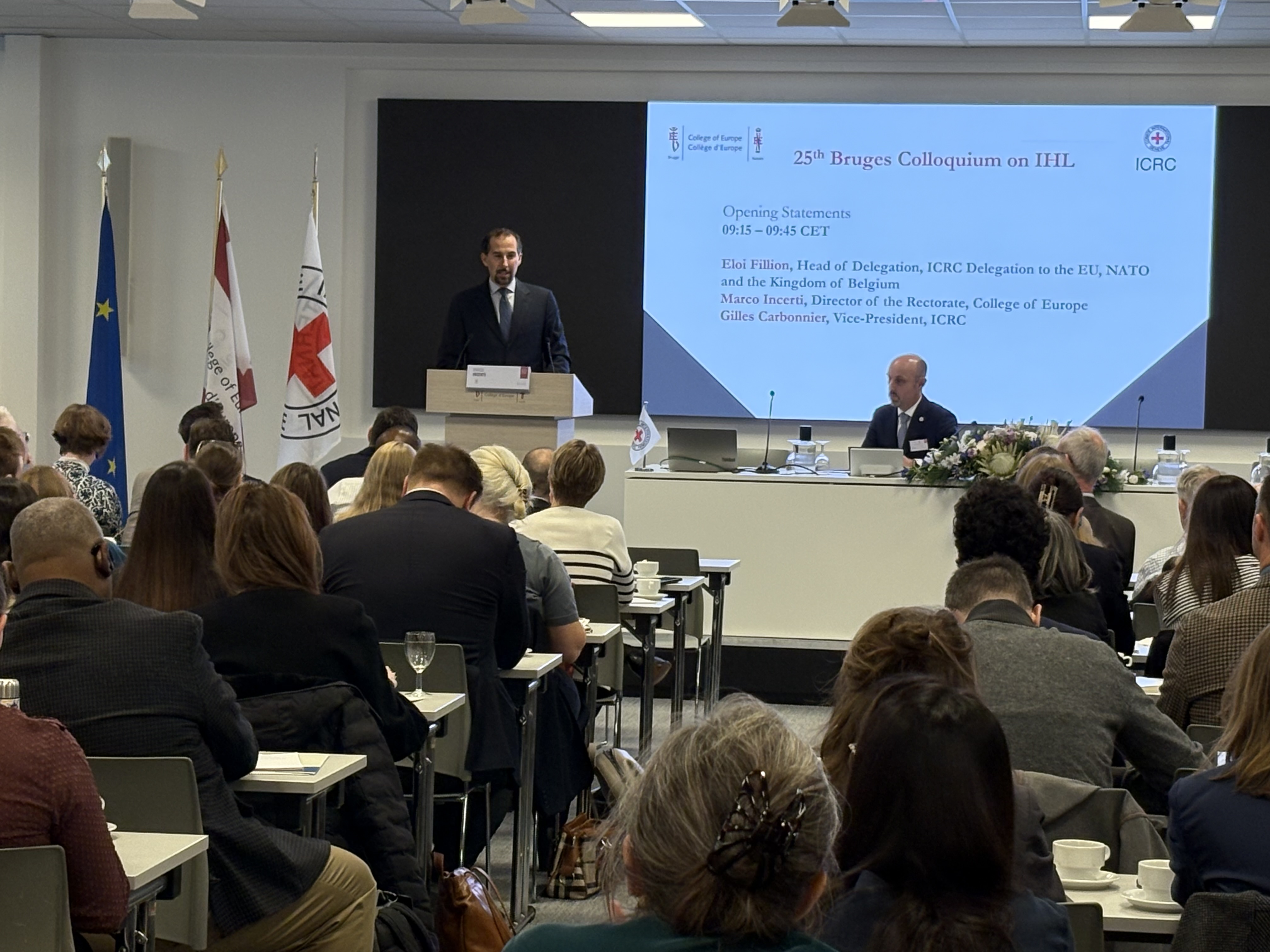
The International Committee of the Red Cross (ICRC) and the College of Europe opened last Thursday the 25th edition of the Bruges Colloquium on International Humanitarian Law (IHL), bringing together experts, practitioners, academics and students for two days of in-person exchanges on some of the most pressing challenges affecting the protection of people in armed conflict.
This year’s Colloquium, held on 13–14 November in Bruges, was dedicated to the theme “Standing Up for IHL: Building a Common Understanding Around the Law That Protects in War.” The milestone 25th edition underscored that IHL remains fit for purpose but requires strong political commitment to be effective.
Marco Incerti, Director of the Rectorate of the College of Europe, opened the event on behalf of the Rector, alongside Eloi Fillion, Head of the ICRC Delegation to the EU, NATO and the Kingdom of Belgium, and Gilles Carbonnier, Vice-President of the ICRC.
The opening keynote was delivered by Judge Theodor Meron, former President of the International Criminal Tribunal for the former Yugoslavia (ICTY). Judge Meron set the tone for the discussions by stressing that respect for IHL should be part of collective conscience and culture and must be interpreted in good faith by maximising protection. Kajsa Ollongren, EU Special Representative for Human Rights, and John Swords, Director of the NATO Office of Legal Affairs, also delivered keynote speeches.
Over the course of the two days, participants examined how to deepen understanding and practical application of IHL through five thematic panels, based on the workstreams of the Global IHL Initiative. Panel discussions addressed the protection of civilian and medical infrastructure, the challenges posed by digitalized warfare, the need to rethink certain aspects of IHL in naval warfare, and the importance of respecting IHL before, during, and after conflict as an essential investment in lasting peace and stability.
Further information about the programme and background on the Bruges Colloquium can be found on the official website: www.brugescolloquium.org