This second issue of Duodecim Astra, titled “Unfolding European Integration”, was published by students of the Madeleine Albright promotion of the College of Europe. The co-directors, Erell Mourouga and Paul Desplaces would like to thank the 2023-24 committee of editors who peer-reviewed all papers and allowed this issue to come to life. The team would also like to thank the scientific committee that generously supported our work with their time and advice, and above all, the authors that for their trust throughout the publication process.
“Unfolding the European project” at a time of institutional enlargement, drive for strategic autonomy, and growing international conflicts in its eastern and southern neighbourhoods, the EU stands in a historical momentum – which encourages us to examine the past and look to the future, so as to best understand present policy crossroads.
What better time to engage in this exercise than during a year of anniversaries? These yearly dates enable us to reflect on what has been achieved on the road that has brought us to the EU as we know it today. We celebrate on this very year the thirtieth anniversary of the coming into effect of the Maastricht Treaty, the twentieth anniversary of the launching of the European Neighbourhood Policy, and the opening of the College of Europe campus in Tirana, Albania, seventy-five years after the creation of the College in Bruges. It is thus with such anniversaries in mind that the 2024 Duodecim Astra issue invites a reflection on the process of European integration, analysing the continued construction of the EU amidst change – both institutional and geopolitical.
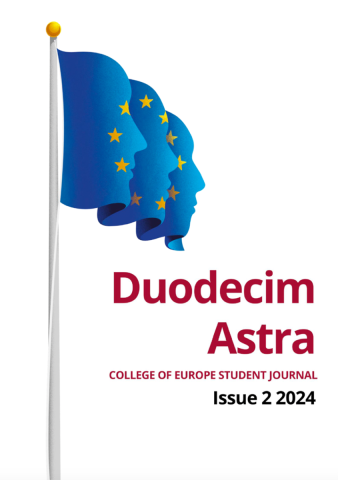
The guiding principle of this issue is thus to unfold and dissect the European integration project, at large. Every article explores a different facet of such process – from its most contemporary backlash that is the political phenomena of the far-right, to a historical analysis of Anglo-American rapprochement, from a top-down analysis of the creation of a European diplomatic esprit de corps to a bottom-up ethnographic analysis of Russian identity in Europe, or through its legal implications in the judicialization of national constitutional identities and exploration of judicial dialogue in the preservation of the rule of law. Like differing facets of one’s own individuality, European integration is an ever moving and ever evolving process. The illustration by Gustaf Öhrnell Hjalmars–originally created for the Get Out & Vote initiative launched by Fine Acts during the 2024 European Parliament elections and kindly extended to illustrating our issue – represents this very notion. Created in the framework of a vast campaign in support of European unity and values, we join this pan-European artistic initiative with critical reflections in this academic publication on the process of European integration. That this happens, at a time of great institutional and societal development is not coincidental: times of upheaval lead to revolutions in the understanding of how integration comes about.
The EU is in the midst of an enlargement process, implying institutional questioning concerning the nature and direction of such a transformation, but also on the very meaning of Europe and on the opportunities and challenges accompanying such strategic recalibration. In an era characterised by poly-crises and geopolitical conflicts in the EU’s neighbouring regions to the east and to the south, this issue explores European integration from an array of lenses, reflecting the ever-changing direction of Europe.
Duodecim Astra, Unfolding European Integration, Issue 2, December 2024