EU regulatory responses to crises : adaptation or transformation?
Description
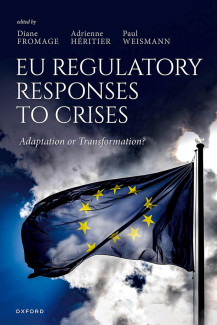
Diane FROMAGE et al.EU regulatory responses to crises : adaptation or transformation? Oxford, United Kingdom ; New York, NY : Oxford University Press, 2025, xxiii, 213p.
As a reaction to these crises, EU rule-making in these fields has developed in various ways. These changes - essentially brought about only on the basis of secondary law - have had an institutional dimension, i.e. they concerned the actors involved in rule-making. Beyond that, the changes have also affected the shape or nature of the rules - such as the increasing use of non-binding rules ("soft law") - and the process of rule-making as such. Further dimensions of this change concern the cooperation with national bodies. Additionally, the substance of existing rules (including primary law) has been reconsidered as a result of unprecedented challenges. In this vein, we have seen a deviation in practice from the Dublin system as regards the distribution of refugees or the EU indebting itself on a considerable scale in the wake of the pandemic.
As a reaction to these crises, EU rule-making in these fields has developed in various ways. These changes - essentially brought about only on the basis of secondary law - have had an institutional dimension, i.e. they concerned the actors involved in rule-making. Beyond that, the changes have also affected the shape or nature of the rules - such as the increasing use of non-binding rules ("soft law") - and the process of rule-making as such. Further dimensions of this change concern the cooperation with national bodies. Additionally, the substance of existing rules (including primary law) has been reconsidered as a result of unprecedented challenges. In this vein, we have seen a deviation in practice from the Dublin system as regards the distribution of refugees or the EU indebting itself on a considerable scale in the wake of the pandemic.